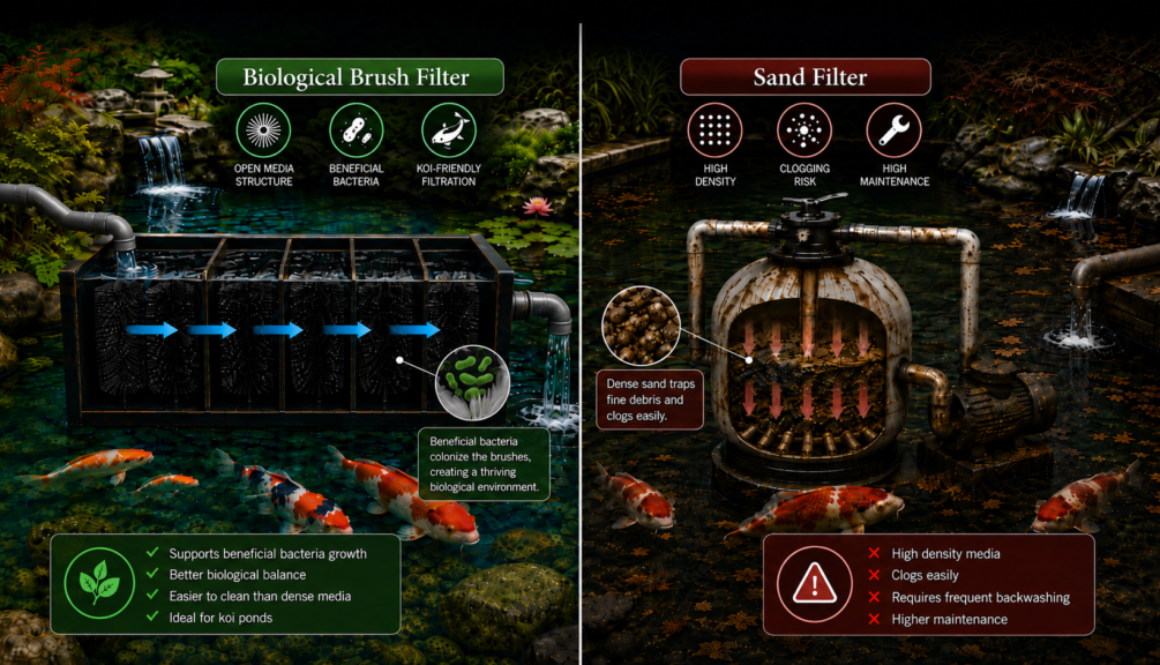
Biological Filter vs Sand Filter: Which Is Right for Your Koi Pond?
If you’re setting up a koi pond in South Africa, chances are someone has already told you to install a sand filter. It’s the go-to recommendation from most swimming pool installers — but is it actually the right choice for koi? At Koi Empire, four generations of koi-keeping experience says otherwise. Here’s why.
The Problem with Sand Filters
Sand filters are popular in South Africa mainly because they’re familiar. Swimming pool technicians who market themselves as “koi pond experts” often simply install the same high-density sand or filter media they’d use in a swimming pool.
On the surface, that sounds convenient. In practice, sand filters create ongoing problems for koi keepers:
- Constant maintenance. Sand filters need backwashing every 2 to 3 days. Miss a few cycles and you’re not maintaining a pond anymore — you’ve become what we call a “koi slave,” chained to a filter schedule.
- Water quality risk. If a sand or mechanical filter isn’t cleaned regularly, ammonia, nitrite, and nitrate build up fast — putting your koi at real risk of sickness or death.
- Hobby burnout. This is the biggest hidden cost. Many people get into koi keeping excited and optimistic, only to lose interest within a year because the maintenance became a chore instead of a hobby.
Why We Recommend Biological Filtration Instead
A biological filter system works completely differently — and far more closely to how nature actually cleans water.
Instead of trapping waste in sand or mechanical media that needs constant cleaning, a biological filter houses beneficial bacteria across multiple layers outside the pond itself. As water flows through these layers, bacteria break down the toxins produced by fish waste. Clean water then flows back into the pond, completing a natural, self-sustaining cycle.
No daily backwashing. No sand to replace. Just a system that mimics nature and does the hard work for you.
Is a Biological Filter Actually Necessary?
Short answer: yes. Here’s the science behind why.
Ammonia is produced naturally by fish waste and decaying matter in the pond. Left unchecked, it can seriously harm your koi.
Nitrite is toxic to koi and other pond fish. Elevated nitrite levels compromise a fish’s ability to absorb oxygen — even if the water looks perfectly clear.
Nitrate, while less immediately dangerous, is a major nutrient source for algae. This is exactly why so many koi ponds in South Africa battle persistent string algae or blanket weed, no matter how strong their UV clarifier is. A UV light can’t fix a water clarity problem caused by an imbalanced bacteria colony — it can only treat what’s already in the water, not stop the root cause.
The Bottom Line
If you want a koi pond that’s genuinely enjoyable to own — not one that owns you — biological filtration is the smarter long-term investment. It costs less in ongoing maintenance, keeps your water chemistry more stable, and gives your koi the healthiest possible environment to grow and thrive.
Ready to Upgrade Your Pond’s Filtration?
At Koi Empire, we supply everything you need to build or upgrade a proper biological filtration system — including our Water Conditioner, which boosts beneficial bacteria in new and existing filter systems and treats up to 100,000L of pond water.