Why Cheap Koi Food Is Costing You More Than You Think
Walk into almost any pet shop or browse online, and you’ll find koi food selling for R80–R100 per kilogram. It looks like a great deal. But before you buy, ask yourself one question: how is that even possible?
Let’s Do the Maths
Think about everything that has to happen before that bag of food reaches your hands:
- Raw materials — quality ingredients like fish meal, astaxanthin, and spirulina are genuinely expensive on their own
- Manufacturing — processing, pelleting, and quality control
- Packaging — the bag, the printing, the sealing
- Import and shipping costs — if the food or its ingredients come from overseas
- The seller’s margin — wholesalers, distributors, and retailers all need to profit, or they wouldn’t be in business
By the time you account for all of that, a genuinely high-quality koi food simply cannot cost R80–R100 per kg and still contain real, nutrient-dense ingredients. Something in that chain has to give — and it’s almost always the ingredients themselves.
So the real question isn’t “how cheap can I find koi food?” It’s: how much actual value is left in that bag once everyone in the chain has taken their cut?
What’s Really in Cheap Koi Food?
Premium raw materials like fish meal, astaxanthin, and spirulina are some of the most expensive ingredients in koi nutrition — and for good reason.
- Fish meal provides high-quality, easily digestible protein — the foundation of real koi growth
- Astaxanthin is a natural pigment that enhances vivid red and orange colouration
- Spirulina is a nutrient-dense algae that supports both colour development and overall immune health
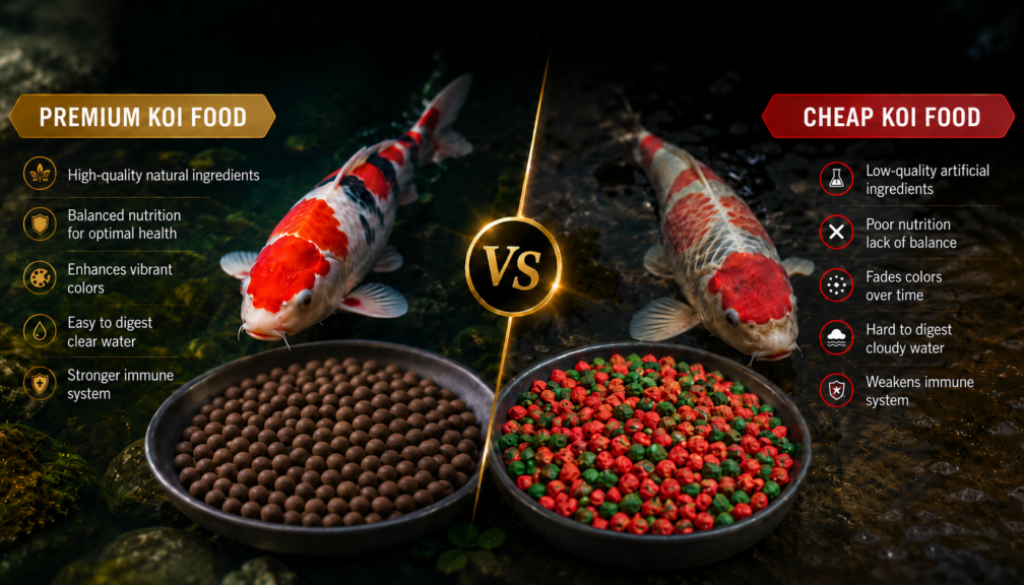
These ingredients cost real money. When a food is priced far below what quality ingredients would allow, manufacturers typically substitute them with cheap fillers — low-grade grains, plant by-products, and synthetic binders that are far less nutritious and far less digestible.
Would You Eat Like That?
Here’s a thought experiment. Imagine eating nothing but cheap, filler-based food every single day for years. No real protein, no real nutrients — just empty calories designed to fill you up as cheaply as possible.
Would you feel healthy? Would you have energy, strong immunity, good skin, a long lifespan? Almost certainly not. Over time, poor nutrition catches up with any living thing.
Koi are no different. What you feed them daily, over months and years, directly determines their growth, colour, immune strength, and lifespan. There’s no shortcut around good nutrition — not for us, and not for them.
Protein: The Number That Actually Matters
One of the simplest ways to judge koi food quality is protein content. Optimal koi food should contain at least 30% protein — this is what fuels healthy growth and supports their metabolism.
Next time you’re comparing koi food, flip the bag over and actually check the guaranteed analysis. Ask yourself:
- What’s the protein percentage?
- Where is that protein coming from — real fish meal, or cheap plant fillers?
- Does the price realistically match what real protein-rich ingredients would cost?
If a bag is cheap and claims high protein, something doesn’t add up.
The Colour Question: Where Does That Vibrant Colour Actually Come From?
Colour enhancement is one of the biggest selling points in koi food — but it’s worth asking exactly how a cheap pellet is producing that colour.
Genuine colour enhancement comes from natural pigment sources like astaxanthin and spirulina, which koi absorb and express through their skin over time. This is a real biological process, and the ingredients that drive it aren’t cheap.
If a low-cost food still claims strong colour-enhancing results, it’s worth questioning what’s actually producing that effect — and whether it’s giving your koi genuine nutritional benefit, or just a marketing claim.
Poor Digestion, Poor Water Quality
Here’s the part most koi keepers overlook: cheap food doesn’t just affect your koi — it affects your entire pond.
Low-quality ingredients are harder for koi to digest. When a fish can’t properly break down and absorb what it’s eating, a large portion of that food passes straight through undigested. That waste doesn’t disappear — it breaks down in your pond water, driving up ammonia and nitrate levels, feeding algae growth, and putting extra strain on your filtration system.
So when you save a few Rand on a bag of cheap food, you often end up paying for it elsewhere — more water treatments, more filter maintenance, more algae control. The savings were never really there to begin with.
The Real Cost of “Cheap”
When you actually break it down, cheap koi food isn’t cheap at all. You’re paying for:
- Lower protein and poor-quality ingredients your koi can barely digest
- Slower growth and duller colour, despite feeding daily
- Extra strain on your pond’s water quality and filtration system
- More money spent down the line fixing problems that quality food would have prevented in the first place
Feed Real Nutrition, Not Just Volume
At Koi Empire, our Qualikoi range is built on real ingredients — including fish meal, astaxanthin, and spirulina — with protein levels that actually support genuine growth and colour development. It’s not the cheapest bag on the shelf, but it’s honest about what’s actually inside it.